
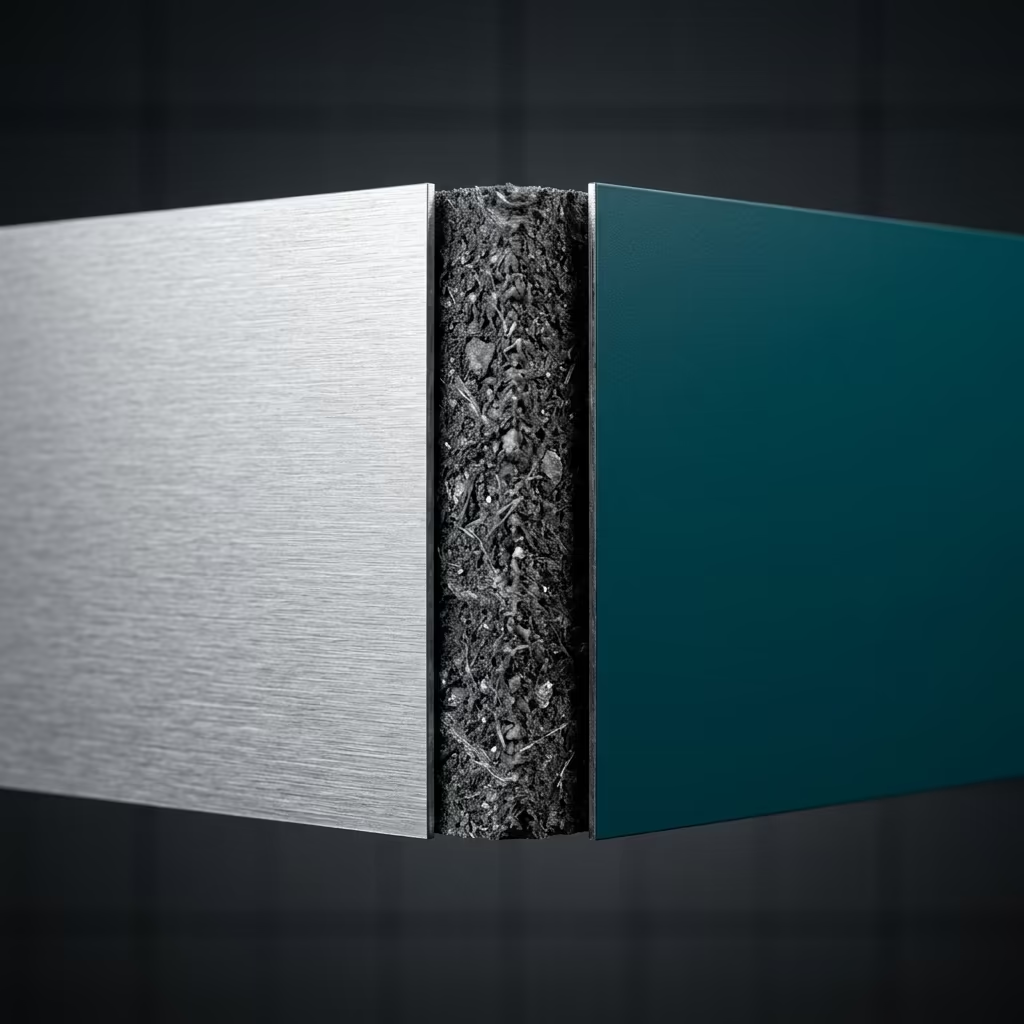
The three Alucobond color families
Original Alucobond is organized into three families: Metallic, Natural and Solid. Each family has its own design language and its own use cases.
Within each family there are dozens of standard colors, plus custom finishes available through the manufacturer for larger projects. Most decisions happen within the standard ranges. Custom colors carry significant cost uplifts and longer lead times.
Metallic finishes
Brushed silver, champagne gold, titanium bronze, anthracite. The metallic family delivers the look most clients associate with high-end Alucobond. The PVDF coating contains genuine metallic pigments that shift subtly with light and angle. Up close they look like brushed metal. From distance they look like architecture.
Metallic finishes pair well with glazed areas, exposed concrete and stone elements. They are common on hi-tech office buildings, banks and luxury residential. They are less common on private villas, where they can feel cold.
Natural finishes
Wood effect, stone effect, concrete effect. The natural family uses high-resolution printing onto the PVDF coating to mimic natural materials. Oak grain, walnut, Jerusalem stone, weathered concrete. The visual quality is convincing at conversational distance, and the practical performance is identical to any other Alucobond panel.
Natural finishes are popular for private villas, boutique residential and projects that want warmth without the maintenance and weight of real wood or stone. The tradeoff is that they read as Alucobond up close, especially on close inspection. For most projects, this is fine.
Solid colors
Whites, grays, deep blacks, accent blues and reds. Solid colors are the workhorse of the industry. They cost the least, they ship the fastest, and they are the most forgiving of installation tolerances.
Solid colors are heavily used on commercial buildings, schools, hospitals and the back elevations of mixed-finish projects. A well-chosen solid color on a clean facade often outperforms a more elaborate finish on a complex one.
How do you choose a colour you will not regret?
Colour is the decision with the longest payback period on the project. The panel installed today will hold that colour for 25 years. Five rules that consistently produce good outcomes:
- Always view samples outdoors in daylight, not under showroom lighting. Metallic finishes shift dramatically between fluorescent light and direct sun.
- View the sample in the actual installed orientation. A small swatch held in the hand does not predict how a 2-metre panel reads on the facade.
- Consider the building context. A bold colour on a corner building reads differently than the same colour in a row of houses. Walk the site.
- For most residential projects a single colour works better than a multi-colour facade. Restraint ages well. Trends do not.
- For commercial, brand alignment beats personal taste. Take the brand book and pick the closest standard match to its RAL or Pantone value.
What happens to the colour after 20 years in Israeli sun
A quality PVDF coating holds colour exceptionally well. Major manufacturers warranty against meaningful colour shift for 15 to 20 years, and in practice well-specified PVDF panels show only minor change after 25 to 30 years of exposure, fading evenly rather than in patches. Cheap polyester coatings, by contrast, can fade within 5 to 8 years and unevenly. Coating specifications can be verified on the manufacturer’s product pages.
What sets the price
We do not publish price bands, because the number changes from project to project. These are the factors that move it most:
- Facade geometry. The number of openings, corners and folds per m². A large flat elevation costs far less per m² than a detailed one.
- Substrate condition. On an existing building this is the hardest item to judge remotely, and the one that surprises people in cheap quotations.
- Access equipment. Standard scaffolding, a suspended platform or rope access. At height this is a significant line of its own.
- Panel grade and finish. Fire-retardant or mineral core, and a standard finish versus metallic, wood-effect or a custom RAL colour.
- Project size. A larger area lowers the cost per m² through repetition and installation efficiency.
A binding quotation follows a discovery call and a site visit, in writing and itemised line by line. Book a site visit.
Key takeaways
- Three families: solid colour (baseline), metallic (+20 to 30%), natural (+25 to 35%).
- Custom colour: +20 to 40%, 200 to 500 m² minimum, long lead time.
- PVDF holds colour for 20 years and fades evenly. Cheap polyester fades in patches within 5 to 8 years.
- Always assess samples in daylight, in the installed orientation, on site.
- Concentrate the expensive finish on street-facing elevations and use solid colour at the rear.
Further reading: how finish choice affects total cost, the complete private villa facade guide, and the Alucobond finishes gallery.
Frequently asked questions
Will the color fade over time?
Premium PVDF coatings hold color exceptionally well. Major manufacturers warranty against meaningful color shift for 15 to 20 years. In practice, properly specified PVDF panels show only minor color changes after 25 to 30 years of exposure, and even then they fade evenly rather than blotchily.
Can colors be mixed on one facade?
Yes, and it is common on contemporary projects. The technical execution requires careful detailing where colors meet, and we recommend the architect specifies the mixing in elevation drawings before fabrication starts.
Are custom colors available?
Yes, through manufacturer custom-color programs. Custom colors require minimum order quantities (usually 200 to 500 square meters) and longer lead times. They cost 20 to 40 percent more than standard colors but allow exact brand or design matching.
What about anti-graffiti finishes?
Most premium PVDF coatings include anti-graffiti properties as standard. Most spray paints can be removed with mild solvent and pressure washing without damaging the panel. For commercial street-level installations, this is a routine specification.


